


An Indonesian “helper” worked for nine years in the home of one of Singapore’s richest and most famous corporate honchos. In March 2016, his wife, the helper’s employer, ordered her to also work in their son’s house, which is illegal (for a helper to work at two locations). She complied. But after son and helper fell out, in October 2016, the rich family suddenly terminated her employment. She was forced to pack her bags and fly home the same day. Disgruntled, she threatened to lodge a complaint with the Ministry of Manpower (MOM) before she left the country (though she didn’t then).
Two days after she left, the family filed a police report, claiming the helper had stolen items from them. In December 2016, she was arrested upon her return to Singapore and was eventually charged with four counts of theft, involving 144 items valued at over S$50,000. In 2019, the District Court sentenced her to jail for two years and two months. In September 2020, the High Court overturned her conviction, citing, among other things, the police’s handling of the evidence and an “improper motive” among some of the family members in filing the police report.
The decorated boss, whose wife was issued a “caution” by MOM and whose son was issued an advisory notice, resigned in shame from a slew of Temasek-linked positions. It emerged during the High Court appeal that the son may have lied to the police (and later the courts) in order to secure her conviction. The public prosecutor eventually charged him, and a fortnight ago the District Court sentenced him to two weeks in prison.
The bare facts of the cases involving foreign domestic worker Parti Liyani, disgraced boss Liew Mun Leong and his son Karl Liew (henceforth Liew) are familiar to many. The entire episode has shone a light on possible structural inequities prevalent in Singapore, including power dynamics between a tycoon, his worker and the police, as well as differential access to justice. (Issues, indeed, that exist in many grossly unequal societies.)
Though some, including Adrian Tan, president of the Law Society, have cheered the sentencing as proof that nobody’s above the law, others have questioned the peculiarities of the prosecution’s case. Unusually, the judge, Eugene Teo, imposed a higher sentence than both the prosecution and defence had asked for (a S$5,000 fine). Teo stated in his Oral Grounds that the prosecution’s submissions “read like a mitigation and were lifted wholesale and repeated for effect by the defence in its own Mitigation & Submissions on Sentence.”
This essay examines the role in this case of Singapore’s public prosecutor, part of the Attorney-General’s Chambers. Was prosecutorial discretion exercised in line with the sentencing principles of deterrence, retribution, rehabilitation and prevention? And how did the prosecution assist the court vis-a-vis the defence, in order to ensure that the offender receives a fair and just punishment?
The public prosecutor (assisted by deputies) carries the responsibilities of reviewing evidence secured by law enforcement agencies and prosecuting criminal offences. If the prosecutor finds that there is sufficient evidence for an offence to be made out, they charge the accused person, who either pleads guilty or claims trial.
When it comes to punishments meted out to offenders, the prosecution has a major influence in two ways. First, the prosecution has the discretion to decide on the number and the nature of charges it will bring against the accused person, which will affect what the accused can be convicted and hence sentenced of. Second, the prosecution can argue for a particular sentence for the accused person, which the court will take into account.
Consider the act in question. At Parti’s first trial in 2018 in the District Court, Liew told Judge Olivia Low that two pieces of women’s clothing, a cream polo t-shirt and a red blouse, belonged to him (even though they did not). For this lie, there are a number of offences for which Liew could have been potentially liable. The prosecution could have charged Liew under section 181 of the Penal Code for making a false statement to a public servant, while under oath on the witness stand, which he knows or believes to be false or does not believe to be true. This carries a maximum punishment of up to three years’ imprisonment and a fine. Alternatively, the prosecution could potentially have charged Liew under section 193 read with section 191, for intentionally giving false evidence in any stage of a judicial proceeding, which carries a maximum punishment of seven years’ imprisonment and a fine.
However, the prosecution opted to charge Liew under section 182 which carried the lowest maximum punishment amongst these sections. The offence here is for giving false information to a public servant, knowing it likely that he will cause the public servant to use their lawful power to the injury of another person. In this case, Liew knew that information was false and knew it to be likely that he would cause the district judge to convict Parti of the theft of those two pieces of clothing. In 2018, an offence under section 182 carried the maximum punishment of up to a year’s imprisonment and/or a fine which may extend to S$5,000. (It’s since been upped to two years’ imprisonment and/or a fine).
Perhaps, the prosecution believed that section 182 was appropriate because it’s easier to prove Liew’s knowledge about the effect of conviction on Parti, and difficult to prove that Liew intentionally gave false evidence or knew that the information was false. Put simply, it's easier to show that Liew knew the impact his words might have; and harder to show that he actually knew they were lies.
Separately, it’s also possible that the prosecution and defence had made a (permissible) pact. Criminal Case Management System meetings, which are meetings between prosecutors and the defence without the presence of the accused, to discuss the case frankly, may have occurred in the earlier parts of the case. These meetings are meant for the defence to glean more information about the accused’s admissions to the police and other available evidence, and are held before the accused decides whether to plead guilty or not, to facilitate their decision-making. The defence could also have sent letters called “written representations” to the prosecution. This may have led the prosecution to proceed on the less serious charges (Section 182), on account of Liew agreeing to plead guilty, and the circumstances of the case.
If the prosecution had instead charged Liew on section 181 or 193, and Liew had claimed trial as opposed to pleading guilty, the trial would likely turn on the state of Liew’s knowledge or belief about the falsity of the evidence, or his intention in giving false evidence. Details of Liew’s actions then are available in Chan Seng Onn’s High Court decision. For instance, a relevant fact would be Chan’s finding that “once [Parti] made express her desire to complain to MOM [about doing cleaning work in Liew house’s that was outside of her employer Ng’s house] after her sudden termination on 28 October 2016, the Liew family followed up with the police report to ensure her return [to Singapore] would be prevented.” This would suggest that there was an intent to make a false police report, and subsequently, give false evidence to accuse Parti of theft.

Yet, even within the ambit of Section 182 the prosecution could have proceeded on two charges—for giving the false evidence in court, and a false statement to the police. Liew had told the police that he found 119 pieces of clothing belonging to him in boxes packed by Parti. This charge was taken into consideration by the prosecution. When a charge is “taken into consideration” it simply informs the case and the sentence without being the material focus of it.
If instead the prosecution proceeded with the two charges, this could have resulted in Liew being convicted and sentenced on both, with the sentences either running concurrently or consecutively (depending on the Court’s view of whether the charges are committed in a single criminal episode, and whether the total sentence reflects the severity of the offender’s acts). However, the prosecution chose to proceed only on one charge: giving false evidence in court.
Further, the prosecution chose to charge Liew only about the false evidence relating to those two pieces of clothing. It could have charged him with much more. For instance, Liew had testified that two black women’s wallets belonged to him, which were gifted by his family, and he was always using one of them (a Gucci wallet). However, even his own family contradicted his evidence and Chan alluded to the fact that he may have been lying (instead of being mistaken). This lends credence to the proposition that Liew knew that he was giving or intentionally gave false evidence in court.
The prosecution could also have charged Liew for giving false evidence about a blanket Parti was charged with stealing. Liew claimed it was purchased from a shop called Habitat in the UK. His wife testified that she had never seen the item—and its label read “IKEA”.
To summarise the prosecution’s decision-making on the charges ultimately brought:
- On whether to charge Liew under sections 181/193 or section 182, it chose the latter, the one with the least potential punishment;
- Under section 182, it chose to proceed only with one charge (false evidence in court), while the other (false statement to the police) was “taken into consideration”; and
- It didn’t include other bits of evidence such as the two women’s wallets he claimed were his, nor the blanket apparently from Habitat but with an IKEA label, instead focusing simply on a t-shirt and blouse.
As Teo pointed out, this case is “about one of those statements made by [Liew]” (emphasis in original) as reflected in the false statement charge; and “the prosecution has focused only on a small segment” for the false evidence charge. Liew’s case is “only about those two charges as framed by the prosecution.”
There is also the ancillary question of why the elder Liew was not charged since he lodged the police report together with his son, and was the one who identified the various stolen items (albeit items that were eventually not listed in the charges brought against Parti). That said, it may not be ideal to regularly prosecute people who make police reports, even if they may be false, because that might deter others with genuine concerns from making reports.
Apart from having discretion in framing the charges, the prosecution often takes sentencing positions involving longer sentences and/or higher fines than those of the defence. The prosecution’s role is to assist the court in deciding on a sentence that accurately reflects the seriousness of the offence and the culpability of the offender. In doing so, the prosecutor may highlight the aggravating facts, while the offender or his defence counsel may then mitigate.
Notably, in Liew’s case, not only did the prosecution and the defence argue for the identical punishment of a fine of S$5,000, they also filed written submissions to the District Court that were broadly similar.
Teo pointed out that the “same” prosecution’s points—on no actual and potential harm caused; no malice; and that Liew is suffering from Parkinson’s Disease—were “adopted and repeated” in the defence’s Mitigations & Submissions, citing the corresponding paragraphs.
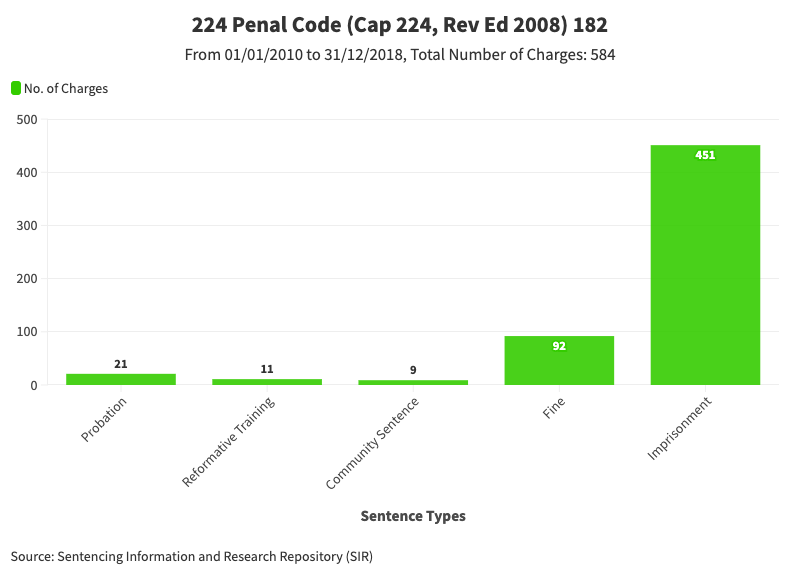
If one looks at the sentencing data for section 182, there have been far more cases with imprisonment sentences than fine-only sentences for the years 2010 to 2018.
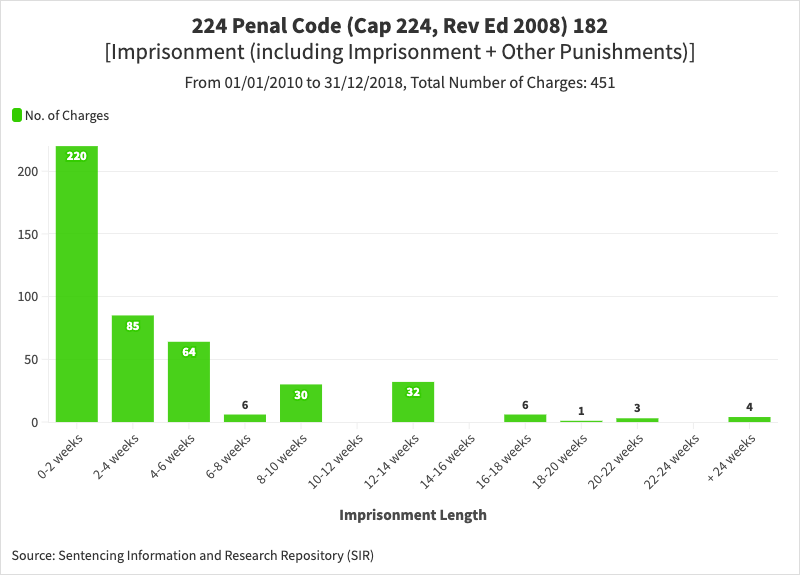
About half of the cases have resulted in up to two weeks’ imprisonment while amongst the other half, a sizeable number of cases led to 2-4 weeks’ imprisonment and 4-6 weeks’ imprisonment.
In the case of Koh Yong Chiah v Public Prosecutor in 2016, the High Court stated that cases in which the offender makes a police report alleging a crime against an innocent party have generally resulted in custodial terms, given the risk of arrest and embarrassment the false allegations create. Meanwhile, cases in which the false information has caused a significant wastage of public resources have also resulted in a custodial term. While the oral grounds by Teo are brief, he must have considered this or similar precedents in deciding that “nothing less than an imprisonment sentence is due for such cases [like Liew’s].”
In Rajeshwary d/o Batumalai v Public Prosecutor in 2014 (cited in above), the offender falsely made a police report alleging that her stepfather had stolen her jewellery, when in fact she had allowed him to pawn it. She made the false report because she was angry with her stepfather for not returning a sum of money that he had borrowed, resulting in her father’s arrest. She recanted her false statement only four and a half months later. The district judge sentenced her to 12 weeks’ imprisonment and on appeal to the High Court, this was reduced to six weeks’ imprisonment.
In Public Prosecutor v Liu Linyan in 2013 (cited in above), the offender falsely accused Ng Say Leong of robbing her. She did so because Ng had accidentally scratched her, and she wanted to ensure that he would not get away. Ng was chased and pinned to the ground by passers-by, before being arrested by the police and held in police custody for 19 hours. A day later, the offender recanted her false statement. The district judge sentenced the offender to two weeks’ imprisonment, and this was upheld on appeal.
Based on the aforesaid cases, factors affecting the sentence include the time it takes for the person giving a false statement to recant it, as well as the impact on other persons. It’s worth noting that Liew never recanted his false evidence in court. Parti was convicted in March 2019 and sentenced to 26 months in prison. She was thereby compelled to appeal, while facing the prospect of jail and the accompanying stress. Her conviction was overturned only in August 2020.
Meanwhile, Parti has also detailed the financial and social impact on her in an edited victim impact statement. The prosecution said they did not require it. Despite the prosecution not including the victim impact statement or highlighting facts relating to the impact on Parti in its submissions, it appears that the court understood the harm caused and thus sentenced Liew to two weeks’ imprisonment.
To conclude, these are some of the questions raised about the role of the prosecution in this case. What were the reasons for pursuing only the lightest possible charge (Section 182) and not the others (Sections 181 or 193)? Why were only two “stolen” items related to fabrications in the spotlight and not the others? Why did the prosecution not recommend jail time, particularly given the precedent of so many other cases?
Answers to these lingering questions will allow Singapore to better understand the limitations of the public prosecutor in such cases, thereby boosting confidence in the overall criminal justice system.
Carol Yuen is an advocate and solicitor by day and night. She is also a passionate Man City fan by night. An activist interested in a multitude of social issues, she is aware of the apparent contradictions between her support for Man City and the purported human rights abuses in the UAE. She enjoys learning languages, watching films and frustrating manspreaders.
The source material for this essay includes these case files:
- Public Prosecutor v Liew Kai Lung, Karl (DAC-922312-2020), Oral Grounds (“Oral Grounds”)
- Parti Liyani v Public Prosecutor [2020] SGHC 187
- Koh Yong Chiah v Public Prosecutor [2016] SGHC 533
Jom’s house style does not permit footnotes, but we are happy to share Carol’s extensively footnoted draft upon request.